


Social Context and Events
The period into which Shelley was born saw some of the most enormous and abrupt changes in the history of European civilization. As the eighteenth century progressed, many social theorists concentrated their attention on how the nature of a society can be transformed into a new kind of association. They were pushed towards certain possibilities by their observations of what was happening around them in England or France.
Notwithstanding these gloomy features of life for many people in Britain in the middle of the 18th century, there is another way of seeing the situation. People grew up belonging to a community, sharing pleasures and adversities, aware of continuity beyond their individual lives, a tradition perpetuated in stories and song. There has been a temptation, and this was a tendency in the Romantic period, to carry his view into sentimentality. In the second half of the century there took place an increasing move of people from the countryside into the towns, partly as a result of Enclosure Acts which, in effect, excluded the peasantry from what had been communally worked land, and partly because the new factories, resulting from technical advances and inventions, created a demand for labourers.
As the process of industrialization accelerated, as the squalor and degradation in the towns became more obvious, it became easier for people to cultivate an idealized and consolatory picture of Britain in an earlier generation.
The Church of England, as the state religion of England, operated as an arm of the state and tended to confirm and justify the political values. Alongside religious changes, a considerable secularization took place in British society, and a number of the leading thinkers at the end of the 18th century, took a positive stand against organized religion, between them Shelley. He was an atheist, and usually the knowledge stops there. He and a friend, the radically named Thomas Jefferson Hogg, were expelled from Oxford for writing The Necessity of Atheism. This book is much tamer than its title suggests, its strongest rhetoric arguing the necessity of being able to argue even about God.
© http://www.victorianweb.org/previctorian/shelley/religion1.html
Shelley’s antagonism towards established Christianity arose primarily from his opposition to the institution of marriage (Victorian Web). Two years after the Necessity of Atheism, Shelley completed another attack on religion called a Refutation of Deism, in which, while arguing about the virgin birth, he proclaims: » It seems less credible that the God whose immensity is uncircumscribed by space, should have committed adultery with a carpenter’s wife, than that some bold knaves or insane dupes had decived the credulous’. Unrestrained about his views in his print, he also made a public display of his atheism.
© Woodcock, Bruce. The selected Poetry and Prose of Shelley
He believed that it was immoral for a man and woman who had ceased to love each other to remain married, and he thought that Christianity had from its earliest times emphasized the perils of sin over the rewards oflove. Three poems, Prometheus Unbound, Mont Blanc, and Hymn to Intellectual Beauty best present his philosophical and religious beliefs. Did Prometheus appear in a work by any other writer, his self-sacrifice and his intercession before the gods on behalf of man would make him a Christ figure. Hymn to Intellectual Beauty has obvious parallels in Wordsworth’s «Ode on the Intimations of Immortality, but differs from them primarily in Shelley’s assumption of the existence of an «unseen power,» the «Spirit of Beauty» whose light alone «gives grace and truth to life’s unquiet dream.» Mont Blanc also places us at once within «the everlasting universe of things» and within the mind. The challenge which this poem presents is the difficulty of grasping Shelley’s idea. It is a mistake to seize on the similarities to other philosophies, especially Plato’s and to conclude that he meant simply to illustrate a philosophic concept. The most intelligent approach assumes that Shelley expressed his idea in poetry because he conceived it that way, and that his rhetorical devices are never mere decoration: this abstract unseen power can only be understood through the similes he draws to the Arve’s physical power.
© http://www.victorianweb.org/previctorian/shelley/religion1.html
In fact, poetry for Shelley seems to operate as a substitute for a discredited religion; the snag is that this divinity touches mankind, including the poet, in an inconstant way and it can not be smarmed. His claims that the poet is the main channel for this Enlightenment and beneficence again emphasises the central, prophetic role of the poet in the society, ‘a nightingale who sits in the darkness and sings to cheer his own solitude with sweet sounds’, and, as happened with the prophets in the Old Testament, he may be disregarded or treated as a madman or outcast of the society. Certainly, in the reactionary climate of his time, Shelley saw the true poet as antagonist and seditious to the orthodoxies of the establishment.
© D.F. Macrae, Alasdir. Percy Bysshe Shelley. Selected Poetry and Prose
Overall, looking back at the period leading up to the end of the 18th century, the observer is struck by an expansionist tendency in Britain. In the wars treaties in Europe, the Americas and Asia in the middle of the century, Britain had secured a huge empire which was to provide the raw materials and the market for a vast increase in its manufacturing industries.
In the midst of the imperialist expansion, the American colonies revolted and succeeded in gaining their independence from Britain. The colonists succeeded partly because they had an ideal to fight for, and this political ideal came to be formulated in the Declaration of the Independence of 1776.
We shall see later that one of Shelley’s ambitions in his poetry was to rebut the false logic of this argument and present revolution in a more favourable light. It was as a parallel to the momentous changes of the French Revolution.
Drops of bloody agony flow
From his white and quivering brow.
Grant a little respite now-
See! A disenchanted nation
Springs like day from desolation;
To Truth its state is dedicate,
And Freedom leads it forth, her mate.
A linked band of linked brothers
Whom Love calls children-
(Act I, 563-572)
Prometheus Unbound
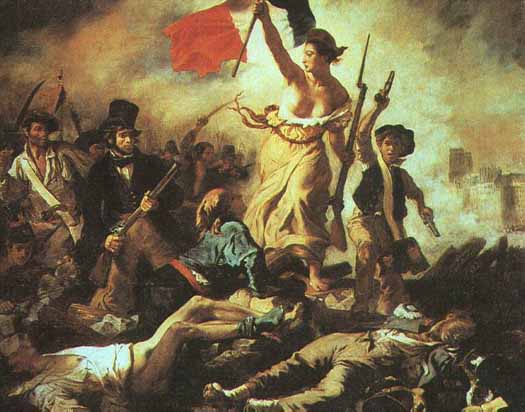
© http://www.rjgeib.com/thoughts/french/liberty.jpg
The nations thronged aroundm and cried aloud,
As with one voice, ‘Truth, Liberty, and Love!’
Suddenly fierce confusion fell from Heaven
Among them: there was a strife, deceit, and fear;
Tyrants rushed in, and did divide the spoil.
(Act I, 650-654)
What was crucial, however, and distinguished Britain from France was the tolerance to new ideas and the pragmatism so envied by the French philosophies. In France as well as in Britain in the 18th century there was much talk of improvement; the two strongest contributory countries to what has come to be called the Age of Enlightenment were France and Scotland.
After all, 1819 seemed an opportune time for radicalism to re-emerge. While Shelley was in Italy, the volcano Etna erupted. Not only were Shelley and Etna erupting but it seemed in Britain as if Shelley’s prediction at the end of his sonnet ‘England in 1819’, that the ‘glorious Phantom’ of Liberty might burst forth again, could come true. After the savage repression of the 1970s, the radical movement had effectively regrouped to incorporate the middle classes. By 1807, there was a new radical movement. Shelley himself may have been more radical in temperament but he too contributed to this reform debate in 1817 with his Pamphlet A Proposal for Putting Reform to the Vote through the Kingdom.
But it was equally evident that the government of Lord Liverpool would not listen to the reform movement and saw their proposals as potentially insurrectionary. Hence the extensive programme for building military barracks throughout England in areas of disinfection. In 1812, the reformist Sir Francis Burdett, had complained that ‘Ministers are intending to establish a military despotism in this country’. Events came quickly to boiling-point. In 1817, the coach of the Prince Regent was mobbed and stoned, the government response was to set up a House of Lords Committee, which reported that ‘a traitorous conspiracy has been formed in the metropolis for the purpose of the overthrowing, by means of a general insurrection, the established Government, laws and Constitution.
By 1819 England was virtually held down by force. Despite the moderation of the reformer’s views, they were much suppressed. Some panicked, others decided to challenge the government’s popular dissent into calls for constitutional change, but they were by no means strong enough to control a widespread popular movement. On the other hand, the government believed that any concessions to reform would unleash the floodgates or revolution. This confrontation led in 1819 to one of the most dramatic events of this period, known as Peterloo massacre.
The reformers organised a meeting to claim the right of freedom for the press and for political organizations, and the vote for a limited franchise. The effects of this event were volcanic and they affected the society hugely.
Over the next twelve years, Shelley wrote his most forceful political poem, The Mask of Anarchy dealing directly with the Peterloo Massacre, and the aftermath of this event reverberates through his later works.
© D.F. Macrae, Alasdir. Percy Bysshe Shelley. Selected Poetry and Prose.